

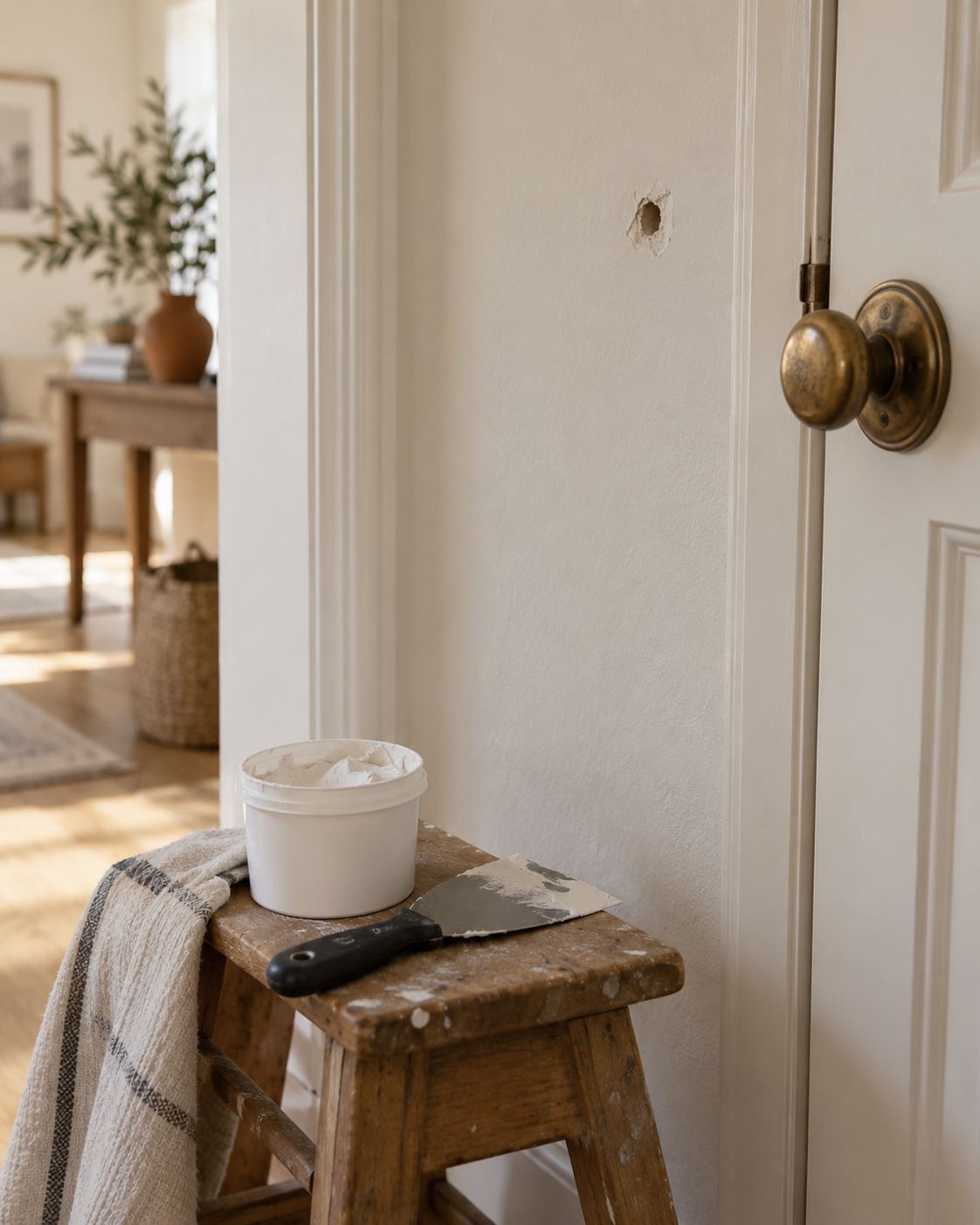
If your home was built before 1978, the paint may contain lead. Test it before you sand, or call a lead-safe certified pro.
What you'll need
You probably have these
Tick them off as you find them.
Only if you're missing something
- Self-adhesive fiberglass mesh tapeOne roll covers lots of cracks$5 to $8
- Lightweight joint compoundA small tub is plenty$6 to $12
- Sanding spongeFine grit$4 to $6
Links go to Amazon. Prices shown are estimates. As an Amazon Associate we earn from qualifying purchases. How we make money
The fix
- 1
Look closely at the crack
Check its width. A hairline crack is thinner than a credit card.
You'll know it's right whenThin and fine is the usual, harmless kind.
- 2
Check for warning signs
Look for a crack wider than 1/4 in, a door that suddenly sticks, or floors that slope. Stop here if you see any.
You'll know it's right whenNone of these? Good. Keep going.
- 3
Mark the ends and wait
Draw a tiny pencil line at each end of the crack and write the date. Check it over a few weeks.
You'll know it's right whenThe crack hasn't grown past your marks.
- 4
Clean out the crack
Scrape away loose bits with a putty knife. Wipe off the dust.
You'll know it's right whenThe edges are solid, with nothing flaking.
- 5
Cover it with mesh tape
Stick self-adhesive mesh tape along the crack. Spread a thin coat of joint compound over it.
You'll know it's right whenThe tape is covered and lies flat.
- 6
Add a second coat
Once dry, often after a few hours, spread a second thin coat a little wider. Feather the edges.
You'll know it's right whenThe line is gone under a smooth layer.
- 7
Sand, prime, and paint
Sand lightly when dry. Prime the patch, then paint to match.
You'll know it's right whenFrom across the room, you can't find it.
That's the fix done. The wall looks like nothing ever happened.
Why it happens
Houses move a little. Wood framing swells and shrinks with the seasons, and new houses settle as they dry out. The corners of door and window openings are where that small movement shows up first. A thin crack there is very common and usually cosmetic.
 Edie's tip
Keep indoor humidity steady with a humidifier in winter or a dehumidifier in summer. Less swing means less movement.
What not to do
- Filling it with caulk or spackle alone
Without tape, the crack usually comes right back through the filler.
- Ignoring warning signs
A crack that keeps growing or comes with sticking doors deserves a pro's eyes.
- Using one thick coat
Thick compound cracks as it dries. Thin coats hold better.
- Panicking over a hairline
Most thin cracks above doors are normal house movement.
When to call a pro
Stop and call a structural engineer if the crack is wider than 1/4 in, keeps getting wider, or runs in a stair-step or zigzag pattern. Call too if it shows up with doors or windows that suddenly stick, sloping floors, or new foundation cracks.
Questions
Will the crack come back?
Sometimes a little, since the house keeps moving with the seasons. Mesh tape makes that much less likely than filler alone.
What does a structural engineer cost?
A home visit is often $300 to $700 in many areas. They're independent, so they aren't trying to sell you a repair.
Is a crack above a door in a new house normal?
Yes, it's common in the first year or two as the wood dries and the house settles. Check your builder's warranty before you patch it.
Written by the DIY Project team and checked against manufacturer instructions. How we check
Updated October 2, 2026.
See something wrong? Tell us.