
If your home was built before 1978, the paint may contain lead. Test it before you sand, or call a lead-safe certified pro.
What you'll need
You probably have these
Tick them off as you find them.
Only if you're missing something
- Lightweight spackleFor nail holes and small dents$5 to $10
- Self-adhesive mesh patchFor holes up to about fist size$5 to $10
- Fine sandpaper or a sanding sponge120 to 220 grit$4 to $8
- Small can of primerOnly if you don't have any$8 to $15
Links go to Amazon. Prices shown are estimates. As an Amazon Associate we earn from qualifying purchases. How we make money
The fix
- 1
Fill nail holes with spackle
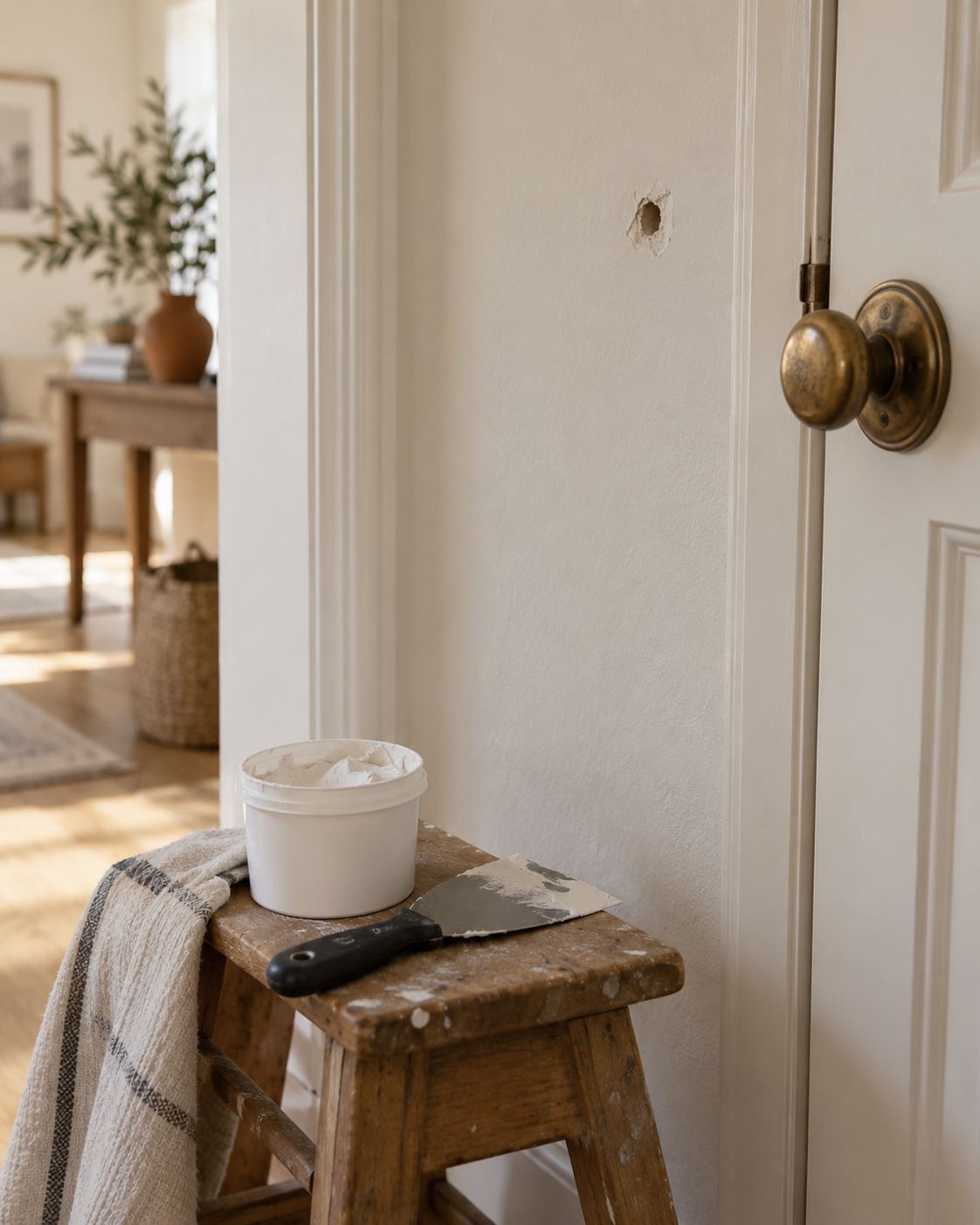
For holes smaller than a pencil, press spackle in with a putty knife. Scrape it flat.
You'll know it's right whenThe hole is filled and the spackle is flush with the wall.
- 2
Trim a bigger hole
For holes up to about fist size, cut away loose paper and crumbly bits with a utility knife. Sand the edges smooth.
You'll know it's right whenThe edges are clean and flat.
- 3
Stick on a mesh patch
Pick a self-adhesive patch about 1 in to 2 in bigger than the hole on every side. Press it flat over the center.
You'll know it's right whenThe patch lies flat with no bubbles.
- 4
Spread a thin coat
Spread joint compound over the patch with a wide putty knife. Feather it out a few inches past the edges.
You'll know it's right whenYou can still see the mesh a little. That's fine.
- 5
Let it dry, then add a second coat
Wait until it's dry, often a few hours. Add a second thin coat a bit wider than the first.
You'll know it's right whenThe patch disappears under a smooth layer.
- 6
Sand it smooth
Sand lightly with fine sandpaper on a block. Wipe the dust off.
You'll know it's right whenRun your hand over it. You can't feel the edges.
- 7
Prime, then paint
Prime the patch first so the paint looks even. Then paint it to match.
You'll know it's right whenLook from the side. The patch is gone.
Step back. That hole is history!
Why it happens
Drywall is a sheet of chalky gypsum wrapped in paper. It's strong enough to hold paint and pictures, but a doorknob or a bumped chair cracks right through it. Small holes from nails and anchors are part of living in a home. None of this means you did anything wrong.
 Edie's tip
Stick a doorstop on the wall or the baseboard where the knob hits.
What not to do
- Using one thick coat
Thick compound cracks and shrinks as it dries. Two or three thin coats look better.
- Skipping the primer
Patches soak up paint differently and can show as a dull spot. Primer evens it out.
- Painting a tiny dot
A small touch-up often shows. Paint out to the nearest corner or edge if you can.
- Cutting blind
Before you cut into a wall, check for wires and pipes behind it.
When to call a pro
Holes bigger than your fist usually need a cut-in drywall patch, a new piece of drywall screwed to a wood backer. Many people can learn it, but a handyman is a good call if you'd rather not. Call a pro too if the drywall is wet, moldy, or you see wires or pipes inside the hole.
Questions
Can I use toothpaste for nail holes?
It works for a quick fill in a pinch, but it shrinks and cracks. Spackle costs a few dollars and lasts.
Spackle or joint compound?
Spackle is great for small holes. Joint compound spreads smoother over bigger patches. Both are fine for most home fixes.
How do I match my paint?
Check for leftover paint in the garage or basement. If you have none, cut a small chip from a hidden spot and take it to a paint store to match.
Will a landlord notice?
A well-sanded, primed, and painted patch is very hard to spot. Matching the paint sheen matters as much as the color.
Written by the DIY Project team and checked against manufacturer instructions. How we check
Updated October 2, 2026.
See something wrong? Tell us.